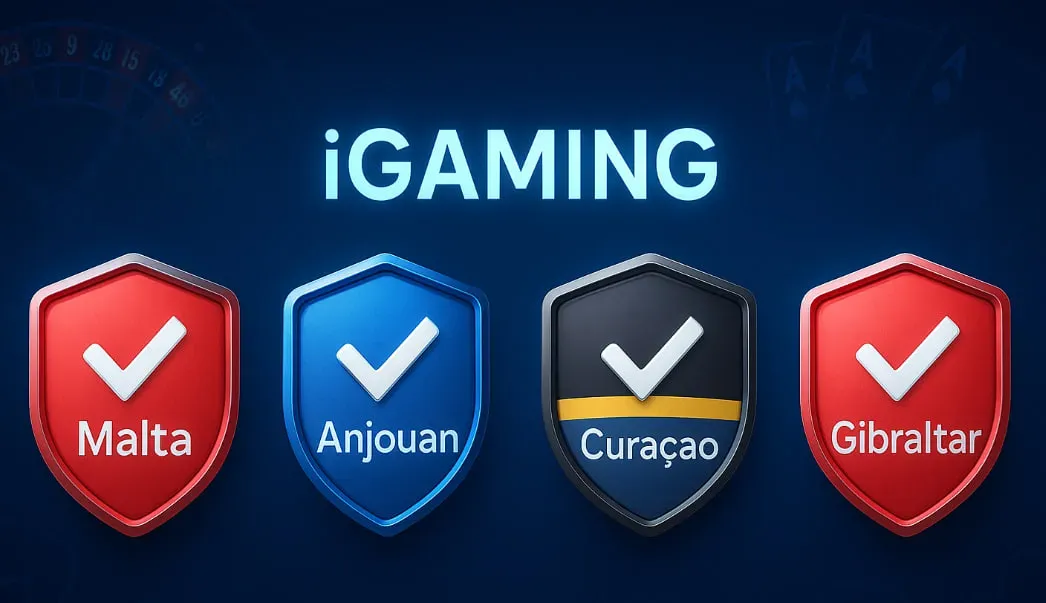
iGaming Licenses Explained: From Gibraltar and Anjouan to Malta, Curaçao, and Costa Rica
17 November 2025
Player Guarantees, Regulatory Strength, Fake Verifiers, and the Complete Overview
Online gambling platforms operate through licenses issued by specific jurisdictions. For players, this determines not only whether the operator is legally registered, but also which protections, dispute-resolution mechanisms, and regulatory oversight apply to the casino or sportsbook.
This article provides a comprehensive breakdown of all significant iGaming licenses, including:
Gibraltar
Anjouan (Comoros)
Malta (MGA)
Curaçao: old system vs. new LOK regulatory model
Costa Rica
Additionally, we review:
Actual guarantees for players
Comparative trust levels
Fake license verifiers and pseudo-regulators
How to validate an online casino license
1. Trust Tiers in iGaming Regulation
There is no universal classification of iGaming jurisdictions, but the industry informally recognizes three trust categories based on regulatory rigor, financial controls, and player protection mechanisms.
Tier 1 (High Trust)
These jurisdictions impose strict compliance requirements and maintain real enforcement practices:
Malta (MGA) – comprehensive EU-grade regulatory framework, strong AML/KYC requirements, player protection rules, independent ADR structures.
Gibraltar – long-established licensing regime, strong financial controls, tight oversight of responsible gaming and operator solvency.
Tier 2 (Medium Trust / Strengthening Regulation)
Anjouan – formal gaming legislation and an active licensing authority, developing but still less mature than top-tier regulators.
Curaçao (LOK era) – transitioning from old master-license system to modern, centralized regulation under the Curaçao Gaming Authority (CGA).
Tier 3 (Low Trust / Minimal Oversight)
Costa Rica – no actual gambling license; companies operate under data-processing permits. Regulatory protection for players is extremely limited.
Even top-tier licenses do not eliminate all risks, but statistically the quality of operator oversight varies dramatically across tiers.
2. Gibraltar: A Mature and Highly Regulated iGaming Hub
2.1. Regulatory Structure
Gibraltar’s online gambling sector is supervised by the Gibraltar Regulatory Authority (GRA) alongside the Gambling Commissioner. Gibraltar has licensed remote gaming operators for over 20 years and is known for its stringent standards.
2.2. Operator Requirements
Licensed entities must comply with:
Fit-and-proper checks on ownership and management
Strong financial controls and proof of solvency
Clear protection of player funds
Full AML/KYC compliance
Independent testing of RNG and RTP
Regular audits and reporting obligations
These controls ensure that operators maintain liquidity to honor player balances and withdrawals.
2.3. Player Guarantees
Gibraltar enforces:
Responsible gaming policies (limits, exclusion tools, monitoring)
Clear dispute-resolution mechanisms with escalation to the regulator
Significant penalties, including license suspension, for violations
Bottom line: Gibraltar is one of the strongest global licensing jurisdictions. Players receive meaningful oversight and credible protection.
3. Anjouan (Comoros): The Rapidly Growing Offshore License
3.1. Legal Basis
Anjouan operates under the Computer Gaming Licensing Act of 2005, which provides a specific regulatory framework for online gambling.
The licensing authority—Gaming Control Anjouan—issues and supervises both B2C and B2B licenses.
3.2. License Types
B2C licenses for casinos, sportsbooks, poker rooms, betting exchanges, etc.
B2B licenses for platform providers, software suppliers, aggregators.
Licenses are typically valid for one year and can cover multiple domains.
3.3. Application Requirements
Operators must provide:
Identity documents, proof of address
Police clearance certificates
Bank and professional references
RNG certifications and platform documentation
Domain ownership proof
3.4. Realistic Level of Oversight
Anjouan has a formal legal framework but:
Offers limited visibility into enforcement cases
Has a smaller compliance infrastructure than Malta or Gibraltar
Provides functional but still developing consumer protection
For players: stronger than unregulated offshore environments but weaker than top-tier jurisdictions.
4. Malta (MGA): The Industry Benchmark
4.1. Who Regulates
The Malta Gaming Authority (MGA) is one of the most respected regulators globally and the first EU member state to formalize a full-scale iGaming regulatory system.
4.2. License Categories
MGA splits licensing into:
Gaming Service License (B2C)
Critical Gaming Supply License (B2B)
Game types include:
Type 1: RNG casino games
Type 2: Fixed-odds betting and sports wagering
Type 3: Peer-to-peer games (poker, bingo)
Type 4: Controlled-skill games (fantasy sports, skill-based gaming)
4.3. Player Protections
The MGA is known for its Player Protection Directive, which requires:
Responsible gaming tools and early-risk detection
Clear bonus terms and fair wagering rules
Independent Alternative Dispute Resolution (ADR) bodies
Segregation or safeguarding of player funds
Strict AML/KYC processes
Mandatory intervention when problem gambling indicators appear
Recent updates further strengthened responsible gaming monitoring and operator accountability.
Conclusion: MGA licensing offers one of the strongest safety nets for players worldwide.
5. Curaçao: From Legacy Sub-Licenses to a Modern Regulator
5.1. Old System (Pre-LOK)
Historically, Curaçao operated via:
A few government-issued master licenses
Master license holders issuing sub-licenses to operators
Key problems:
Lack of a public registry of sub-licensees
Minimal centralized oversight
Mixed reputation due to inconsistent standards across operators
5.2. Modernization: The LOK Reform
On 24 December 2024, the National Ordinance on Games of Chance (LOK) entered into force, establishing the Curaçao Gaming Authority (CGA).
Key reforms:
Direct B2C and B2B licensing by the government
End of the master/sub-license model
Mandatory AML/KYC compliance
Enforcement-based regulatory structure
A standardized Responsible Gaming Policy
Enhanced cybersecurity and operational control requirements
Transitional period for legacy operators to migrate into the new regime
5.3. Impact on Players
Before LOK:
Oversight was inconsistent
Complaints often depended on the policies of master license holders
Limited recourse in disputes
After LOK:
Central authority with enforcement powers
Higher compliance standards
Developing but improving consumer protections
Practical note (2025):
Players should check whether an operator holds a new CGA license or still operates under a legacy sub-license.
6. Costa Rica: A Business Registration, Not a Gambling License
6.1. No Real iGaming Regulation
Costa Rica does not issue gambling licenses.
Instead, companies operate under:
Standard corporate registration
Municipal permits for data processing services
There is no specialized gambling law, no gaming regulator, and no compliance framework.
6.2. Consequences for Players
Because Costa Rica does not regulate gambling:
No oversight of RNG or RTP fairness
No segregation of player funds
No AML/KYC obligations
No dispute-resolution mechanism
No authority to escalate complaints to
Conclusion: Operators may be legitimate businesses, but the jurisdiction itself provides almost zero consumer protection.
7. Fake License Verifiers and Pseudo-Regulators
As online gambling grows, so does the number of websites falsely presenting themselves as:
Official regulatory agencies
International verification services
“Gaming integrity commissions” not recognized by any government
7.1. Common Signs of a Fake Verifier
No legal foundation
Legit regulators refer to specific national laws. Fake sites do not.“Green checkmark” verification
You enter a casino name and always get a “valid license,” with no license numbers or documents.No enforcement history
Real regulators publish information about sanctions, suspensions, and revoked licenses. Fake ones do not.Affiliate links everywhere
Fake verifiers often exist to funnel traffic to partner casinos.Lack of government contact details
No ministries, no statutory addresses, only generic support emails.
8. How Players Can Verify a Casino License
A reliable verification checklist:
Step 1: Identify the license details on the operator’s website.
Should include:
License number
Licensed company name
Jurisdiction
Regulatory authority
Step 2: Check the information against official registries:
MGA: public registry on mga.org.mt
Gibraltar: government licensing lists
Curaçao (LOK): through the CGA’s official channels
Anjouan: via Gaming Control Anjouan’s registry (if available)
Step 3: Confirm domain validity.
Many registries list approved domains. A mismatch indicates potential fraud.
Step 4: Research enforcement records.
Search “[operator] + fine/suspension/penalty” to see if the company was sanctioned.
Step 5: Evaluate the jurisdiction tier.
Your level of trust should correspond to the strength of the license.
9. Summary Table of Key Jurisdictions
JurisdictionRegulatory ModelPlayer Protection LevelTrust TierMalta (MGA)Full government regulator, EU standardsStrong RG, ADR, AML, strict auditsTier 1GibraltarHighly regulated, government-supervisedSegregated funds, strong enforcementTier 1AnjouanOffshore gaming law + licensing authorityModerate and developing controlsTier 2Curaçao (LOK)Centralized CGA regulatorImproving consumer protection, modern AMLTier 2 (transitioning)Costa RicaNo gambling license; data processing permitsMinimal oversight, operator-drivenTier 3
10. Key Takeaways for Readers
Not all licenses are equal.
The jurisdiction determines the level of oversight and player protection.Malta and Gibraltar remain the gold standard.
Anjouan and the new Curaçao LOK system are emerging, structured offshore alternatives.
Costa Rica is a business registration, not a gaming license.
Fake license verifiers are widespread — players must verify licenses through official government channels.